
Motorhome Weight and Loading | Checklist and Tips from Carado
8 min. reading time

Understanding the right weight
Where can I find the information in the vehicle registration document?
All important weight specifications can be found in the vehicle registration certificate. Just one look is enough to give you a solid foundation for planning your load.
How to read your registration certificate:
- Field F.1: Shows the technically permissible maximum laden mass in kilograms.
- Field F.2: Indicates a potential national limit, which may be relevant for certain models if modifications or special equipment affect the weight.
- Field G: Specifies the unladen weight.
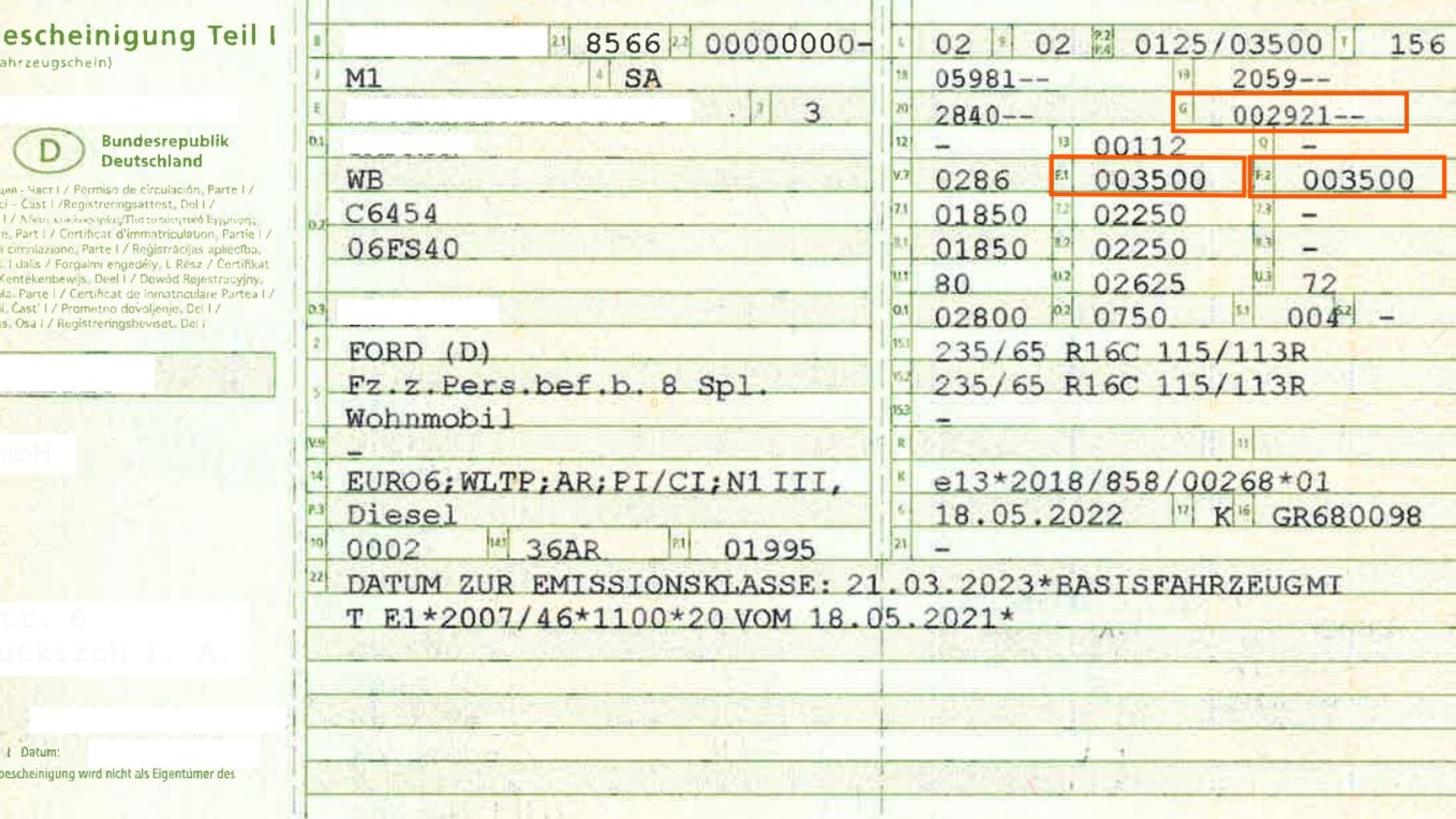
Everything you need to know about vehicle weights and payload
-
- The technically permissible maximum laden mass of the vehicle (e.g. 3,500 kg) is the maximum weight specified by the manufacturer that must not be exceeded.
- You can find this value in the technical specifications of your vehicle. Exceeding this limit may result in fines and, in the worst case, pose a safety risk.
-
Put simply, the mass in running order refers to the base vehicle with standard equipment, plus a legally defined standard weight of 75 kg for the driver. It essentially includes the following components:
- The unladen weight of the vehicle including the body, and all operating consumables such as grease, oil and coolant
- The standard equipment, i.e. all features and fittings that come as part of the factory-installed basic configuration
- A fully filled fresh water tank (as specified for driving conditions; 20 litres) and a fully filled aluminium gas cylinder weighing 16 kg
- A 90% filled fuel tank with fuel
- The driver, whose weight is legally standardised at 75 kg according to EU regulations, regardless of actual weight
You will find the details of the mass in running order for each model in our sales documentation. Please note that the value indicated there is a type-approval standard value verified by authorities. It is legally permissible for the mass in running order of your delivered vehicle to differ from the nominal value provided in the sales documentation. The legally allowed tolerance is ±5%. This regulation accounts for possible weight fluctuations caused by variations in supplier components or manufacturing and weather-related conditions. To illustrate these weight variations, here is an example:
- Mass in running order according to sales documentation: 2,850 kg
- Legally permissible tolerance of ±5%: 142.50 kg
- Legally permissible range for the mass in running order: 2,707.50 kg to 2,992.50 kg
You’ll find the specific weight tolerance range for each model in the technical data section. At Carado, we make every effort to reduce weight fluctuations to the smallest technically unavoidable level. Variations at either end of the range are therefore rare, but despite all optimisations, they cannot be fully eliminated due to technical reasons. To ensure compliance with permissible tolerances, Carado checks the actual weight of each vehicle by weighing it at the end of the production line.
-
- To ensure sufficient payload capacity remains available for luggage and additional equipment, Carado defines a fixed maximum weight for optional extras.
- Optional equipment (also referred to as special or additional features) includes all factory-fitted items that are not part of the standard specification, but which may be ordered by the customer and installed by the manufacturer (e.g. awning, bicycle or motorbike rack, satellite system, solar panels, oven, etc.). You’ll find details on the individual and package weights of available optional extras in our sales documentation. Please note: Accessories fitted after delivery by a dealership or by you personally are not considered optional equipment in this context.
- The vehicle’s “ready-to-drive mass” combined with the weight of the factory-fitted optional equipment for a specific vehicle is referred to as the “actual mass.” You’ll find this value under item 13.2 of the Certificate of Conformity (CoC) you receive with your vehicle. Keep in mind that this figure is also standardised. Since the ready-to-drive mass—as a component of the actual mass—is subject to a legally permitted tolerance of ± 5% (see item 2), the actual mass may differ from the specified nominal value.
-
- A standard passenger weight of 75 kg is calculated for each seat – regardless of the actual weight.
- The driver is already included in the mass in running order. With four seats, this results in a total passenger weight of 225 kg.
-
- The minimum payload is legally required to ensure there is enough space for luggage and accessories. It is calculated using the formula 10 kg × (n + L), where n stands for the number of seats and L represents the vehicle length in metres. For example: with four seats and a length of 6 metres, the minimum payload is 100 kg.
-
- Additional optional equipment increases the vehicle’s weight and reduces the available payload. The maximum weight specified by the manufacturer must not be exceeded.
-
- The Vario seat is an optional fifth passenger seat. Please note that minimum payload and vehicle weight must still be taken into account. As long as these limits are observed, the seat can be used without restriction.
-
- The actual weight of a vehicle is determined by its weight in running order plus the weight of any factory-fitted optional equipment. Due to permitted manufacturing tolerances of ±5%, this weight may vary slightly.
-
- A weight reduction lowers the technically permissible gross weight of the vehicle and thus also reduces the available payload. This may affect the number of seats, the chassis, and the engine. Please consult your local dealer for detailed advice, as a weight reduction can also impact legal requirements such as traffic regulations, toll charges, and insurance policies.
-
- When retrofitting accessories, it is important to check how their weight affects the overall weight of the vehicle. The permitted gross weight and axle load must not be exceeded.
-
Get peace of mind – weigh your motorhome Knowing the exact weight of your motorhome keeps you on the safe side. It ensures you're not overloaded and confirms the correct axle loads. You can weigh your motorhome at the following places:
- Public weighbridges, e.g. at recycling centres or freight companies
- TÜV or DEKRA testing stations, for precise axle load measurements
- Mobile weighing systems – the handy solution for weighing on the go
Here’s how it works:
1. Load your motorhome completely, just as you would for your trip.
2. Drive onto the weighbridge with all passengers and gear on board.
3. Take note of the total weight and compare it to the vehicle’s technically permissible maximum mass.
4. If possible, weigh each axle separately to check weight distribution.Many Carado dealers offer support or can recommend weighing stations near you.
How to calculate your payload correctly – step by step
Smart packing made easy: Know your payload With a simple calculation, you can determine how much payload your motorhome has available: Payload = technically permissible maximum laden mass – unladen weight
- For example, if your Carado has a permissible overall weight of 3,500 kg and an unladen weight of 2,950 kg, you have 550 kg left for everything else—passengers, luggage, accessories and fluids.
- How do water, gas & passengers affect weight?
- Fresh water (100 l): approx. 100 kg
- Gas bottles (2 x 11 kg): approx. 22 kg
- Four people at 75 kg each: 300 kg
- Bicycles on rear rack ≈ 40 kg
Tip: To save weight, fill your fresh water tanks only after arriving at your destination. Every kilo counts, and what feels like enough weight capacity can quickly disappear. Careful planning before each trip is well worth it. Take a moment to consider what you actually need. Leave heavier items at home wherever possible—or opt for lighter versions. Aluminium pots, for example, weigh considerably less than standard cookware, and canned food can be replaced with vacuum-sealed alternatives. Gas can now also be stored in lightweight aluminium cylinders—so why take bulky steel containers with you? You can save even more when it comes to fresh water. Don’t worry—there’s plenty available at your destination. So there’s no need to start out with a full tank. And what about swapping that 35-kilo spare tyre for a far lighter emergency repair kit?
Weight distribution & center of gravity
Heavy luggage belongs down low and centered – ideally between the axles. That keeps your motorhome stable and safe on the road.
- Starting with the heaviest items is key: store them in the underfloor compartments or central storage spaces to lower the vehicle’s center of gravity and improve driving stability. Lighter items should go into overhead lockers. Avoid overloading the rear, for example with bikes or heavy boxes, as this can impact handling.
- Non-slip mats help keep everything in place while driving.
- Bulky items? The shower cubicle or wardrobe might be the perfect fit. And in the back, the spacious rear garage offers plenty of room for bikes, barbecue gear and camping furniture.
- Use lashing straps and anchor points to secure everything tightly. Also, make sure that open shelves and surfaces are cleared off before setting off. That way, nothing becomes a dangerous projectile in case you have to brake suddenly.
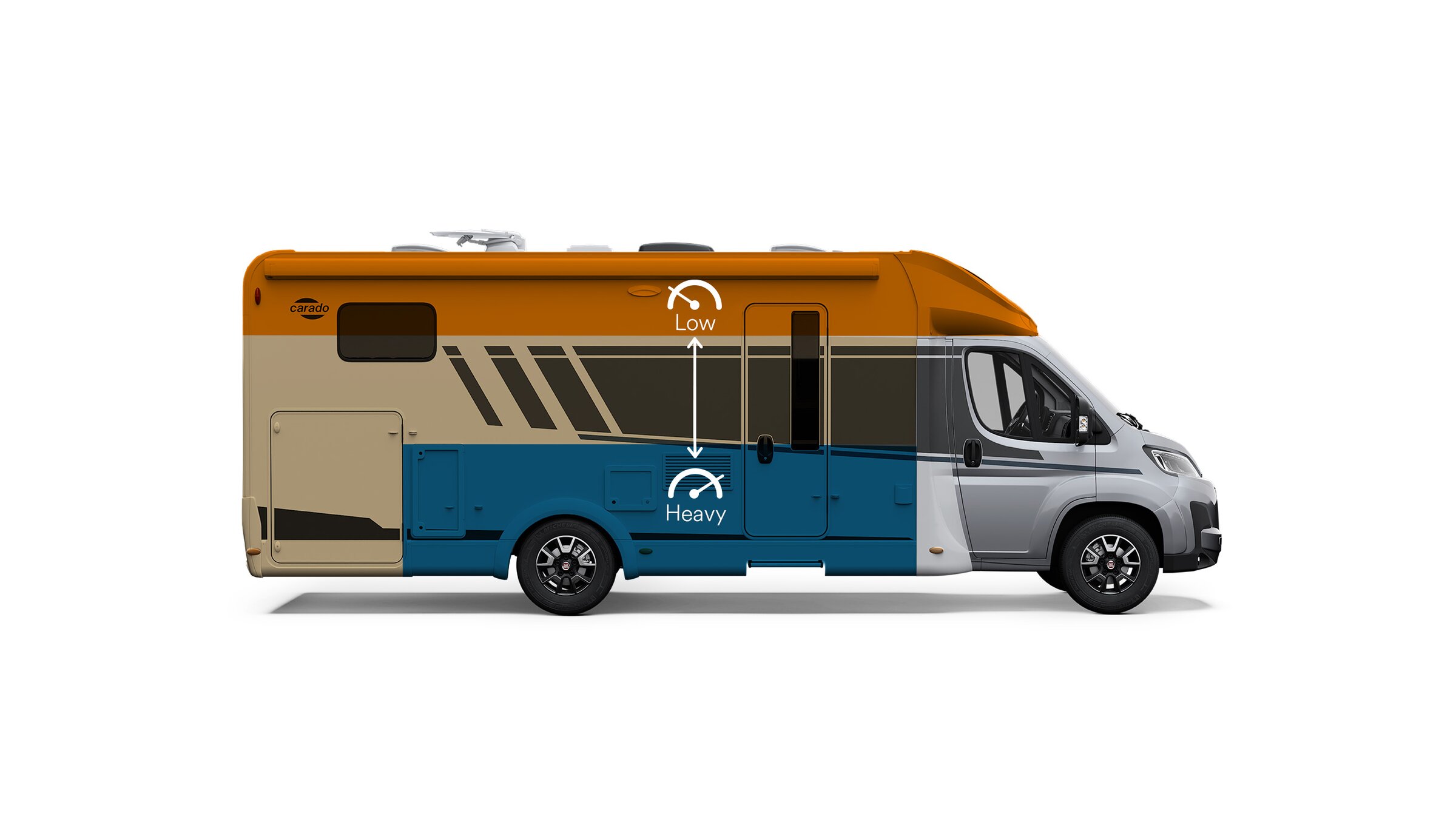
Common mistakes
-
Fill water tanks completely for long-distance journeys
Only fill fluids partially.
-
Store excess luggage securely in the rear compartment
Store heavy items as low and as close to the axle as possible.
-
Transporting unsecured loads
Aim for an even distribution.
Pack smart, travel easy – your checklist for loading up right
Your loading checklist for safe and comfortable travels Stay in control and avoid common mistakes with this practical checklist – for stress-free journeys in your motorhome.
1. Check the maximum permitted weight (registration certificate section F.1)
2. Calculate and stay within the vehicle’s payload capacity
3. Distribute axle load evenly
4. Place heavy items low and centred
5. Store lighter items in upper compartments
6. Factor in liquids (water, gas)
7. Include accessories like bikes and the awning
8. Ensure clear visibility to the rear
9. Lock all cupboards and doors securely
10. If unsure, check the total weight at a certified public weighbridge
Overloading and tolerance – what applies in Europe?
Overloading regulations vary from country to country. Here's an overview with general guideline values. Please note: these figures are for orientation purposes only. Always check the current legal requirements before your trip.
| Country | Tolerance | Possible consequences |
|---|---|---|
| Germany | Approx. 5 % | Fine, possibly points, continuation of journey may be prohibited, information about the fine |
| Austria | Up to 2 % | Warning, fine, owner pays weighing costs |
| Switzerland | None | Strict control, excess weight must be unloaded, fine possible for minor overloading – e.g., ≈ €85 for over 100 kg. |
| Italy | Up to 5 % | Fine, prohibition of continuing journey, no fixed scale |
| France | None | Virtually no tolerance, fines from ≈ €135 to €750 for overloading. From 5%: Prohibition to continue driving |
| Belgium | 2% (gross vehicle weight), 5% (axle load) | Possible fines between ≈ €110 and €330. Cash payment for foreigners, confiscation |
| Spain | Up to 2 % | Graduation according to degree of overload, penalties from ≈ €300 to €4,600 possible. |
| Netherlands | 10 % | Graduation according to degree of overload Penalties from ≈ €130 to €850 for overloading. |


