Keep your motorhome's fresh water tank clean
7 min. reading time

Content
- Why does the water tank in a motorhome need to be cleaned?
- How often should the water tanks in a campervan be cleaned?
- How long does it take to clean the water tank?
- What should you bear in mind before cleaning the water tank?
- Step by step: How to clean the water tank in your motorhome
- Which cleaning products should be used for the motorhome’s water tank?
- How can you prevent the water tank from becoming dirty?
- FAQ
Key points at a glance
Why does the water tank in a motorhome need to be cleaned?
Regular cleaning is important because stubborn deposits build up throughout the water system over time. If these are ignored, there is a risk of health hazards and technical problems:
- Germs and bacteria: Stale water is an ideal breeding ground for bacteria. These multiply rapidly and not only impair the taste and smell of the water, but can also be harmful to health
- Biofilm (slime): An unpleasant, thin film of slime often forms on the inside walls of the tank and hoses. This biofilm is often difficult to see, but acts as a protective shield for germs. It can only be removed by thorough cleaning.
- Limescale deposits: Depending on the water hardness, limescale builds up in your system. Over time, this clogs the pipes and puts strain on the fittings and water pumps, which can lead to expensive repairs.
How often should the water tanks in a campervan be cleaned?
As a general rule, you should clean your motorhome’s water tank every 4–6 weeks during the camping season if you are using it regularly. This ensures that no bacteria, algae or other health hazards build up in the water tank.
- For regular use: Clean your motorhome’s water tank every 4 to 6 weeks during the camping season.
- For occasional use: If you travel less frequently and completely drain the system between trips, it is advisable to clean the tank at least twice a year.
- Before winter storage in autumn: A thorough tank clean is essential before you store the vehicle. Find out more here about how to winterise your motorhome.
- At the start of the season in spring: Before your first trip, it is essential to remove all residues from the period of inactivity.
- Before winter storage in autumn: A thorough tank clean is essential before you store the vehicle. Find out more here about how to winterise your motorhome.
How long does it take to clean the water tank?
How long the cleaning process takes depends primarily on the condition of the tank and the cleaning agent used. The total duration consists of a short active working time and a significantly longer passive soaking time:
- Active working time: You should usually allow around 30 to 45 minutes of active time for emptying, filling, draining and rinsing.
- Soaking time for special cleaners: These often require around 4 to 6 hours for optimal cleaning.
- Soaking time for citric acid: Here, the process takes considerably longer, often ranging from 6 to 12 hours.
- Action time for light cleaning jobs: Quick solutions sometimes take just 1 to 2 hours.
Important note: Always follow the instructions for the specific product exactly. This allows the cleaner to work properly without unnecessarily damaging materials or seals.
What should you bear in mind before cleaning the water tank?
All necessary preparations should be made before cleaning. You should also allow enough time so that all steps can be carried out carefully and without rushing. Before you start, the following points should be in place:
- Choose a suitable location: Ideally, this should be a spot with a fresh water supply, a drain and enough space to work. Official motorhome sites with supply and disposal points, or your own driveway, are perfect for this (provided that the waste water is permitted to flow into the mains drainage system there).
- Have the necessary equipment ready: Keep clean water, a bucket, a hose, gloves and soft cleaning cloths, sponges or gentle brushes to hand. If you are missing anything, you can easily find this basic equipment in any DIY store or supermarket.
- Get the right cleaner: The product must be suitable for fresh water systems and compatible with the material of the tank and seals. It is best to buy specialist cleaners directly from a specialist camping shop so you can get advice beforehand. Very aggressive products such as drain cleaners, strong limescale removers or concentrated vinegar are absolutely unsuitable.
- Check the manufacturer’s instructions: Before cleaning, you must read the cleaner’s instructions regarding dosage, application and contact time. This is the only way to use the product correctly and, above all, safely.
Step by step: How to clean the water tank in your motorhome
Thorough cleaning is best achieved by following a clear procedure. This ensures that not only the tank, but also the pipes and fittings are cleaned.
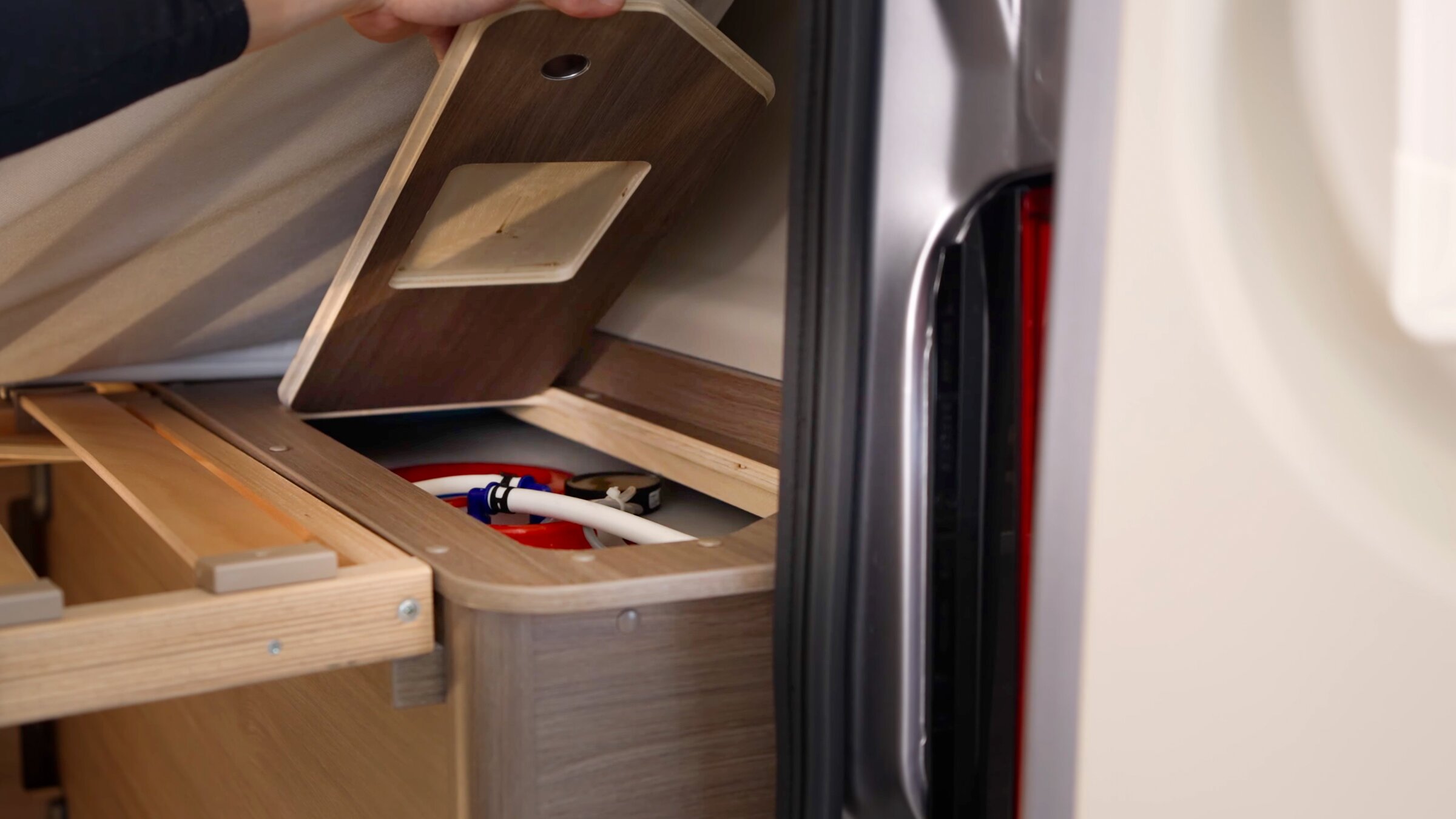
1. Empty the system completely: Drain the water via the outlet and open all taps (switch off the pump whilst doing so) to ensure that any residual water flows out of the pipes.
2. Pre-clean the tank manually: Check the tank for visible deposits and carefully remove them with a soft cloth or brush. Do not use abrasive cleaning aids.
3. Mix the cleaning solution: Prepare the cleaner exactly as per the instructions on the packaging to ensure it remains effective whilst being gentle on the materials.
4. Fill the tank: Pour the mixture into the tank. Depending on the product instructions, the tank does not always need to be filled to the brim.
5. Flush the pipes: Switch on the pump and open all taps one by one to the cold and hot settings until the cleaning solution flows out. This ensures the solution reaches all the hoses.
6. Allow the solution to work: Leave the cleaner to work for the duration specified by the manufacturer to reliably remove all germs and deposits.
7. Drain the solution: After the soaking time, completely empty the tank and pipes via your waste disposal point.
8. Rinse thoroughly: Refill the tank with fresh water and flush the entire system several times until there are no cleaning agent residues left.
Optional: Instead of draining the cleaning solution directly at the waste disposal point in step 7, you can first flush it into the grey water tank. If you then take the vehicle for a short drive, the sloshing solution will also remove any deposits and odours from the waste water tank whilst you are driving. Only then should you head to the waste disposal point for final emptying.
Which cleaning products should be used for the motorhome’s water tank?
Choosing the right product depends on the level of contamination. For a thorough system clean, professional products are usually the safer option:
- Professional cleaners: These specialised products are often based on hydrogen peroxide, chlorine dioxide or active oxygen. They effectively remove biofilm and deposits without damaging hoses or seals. Coloured cleaners offer the advantage that residues in the system are immediately visible during the rinse cycle.
- Home remedies such as citric acid: These are excellent at dissolving limescale, but are largely ineffective against bacteria or biofilm. Important: Only use citric acid when cold or lukewarm, as heat (e.g. in a boiler) can cause it to form hard, insoluble deposits.
- Unsuitable products: You must avoid aggressive household cleaning products, concentrated vinegar or strong industrial limescale removers. These attack rubber seals and hoses, causing them to become brittle over time.
As every water system has different requirements, you should always seek advice from a specialist camping retailer if in doubt. There you will find the right products for the materials used in your system. Furthermore, never mix different cleaning agents together, as this can trigger dangerous chemical reactions.
Comparison: professional cleaning products and home remedies
| Type of cleaner | Examples | Suitable for |
|---|---|---|
| Professional cleaners | Specialist chlorine- or oxygen-based cleaners | Thorough disinfection to remove biofilm, bacteria and heavy soiling. |
| Home remedies | Citric acid | Effectively removes limescale and light deposits (use only with cold or lukewarm water). |
| Not recommended | Concentrated vinegar or harsh household cleaners | Not suitable, as these products can damage seals and hoses. |
How can you prevent the water tank from becoming dirty?
By following a few simple routines as part of your daily camping routine, you can minimise the build-up of germs and deposits right from the start:
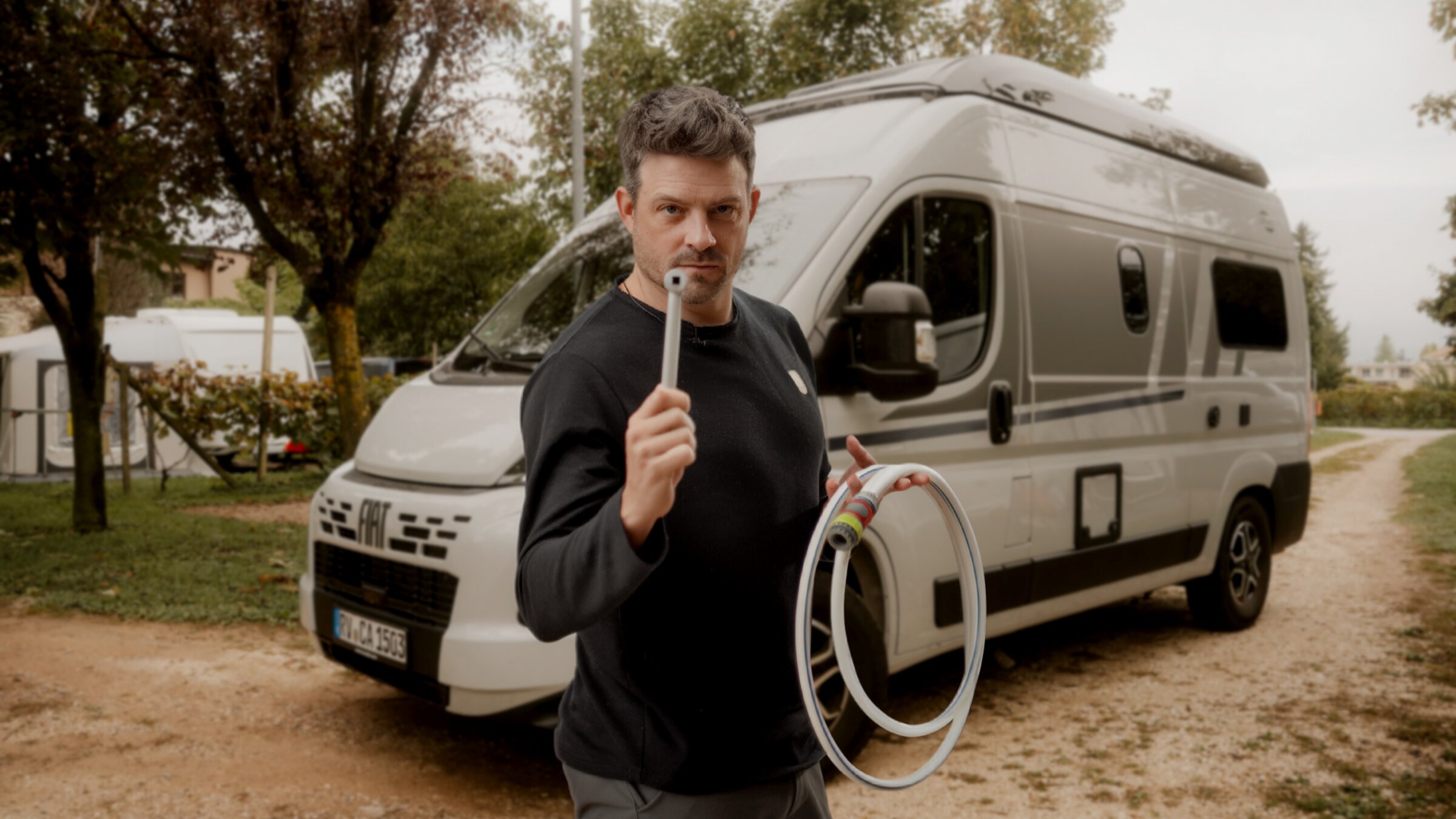
- Fill up with clean water: Use only designated drinking water points and, ideally, your own hose suitable for drinking water to avoid contamination from other people’s equipment.
- Filter out coarse particles: A portable pre-filter when filling the tank traps sand, suspended solids and other particles that could otherwise form a breeding ground for bacteria in the tank.
- Prevent bacterial growth caused by standing water: Change the water every one to two weeks in summer temperatures. Empty the system completely before any extended breaks.
- Prevent mould growth: After emptying the tank, leave all taps and the tank’s inspection cover open so that the system can dry out completely.
- Watch out for warning signs: Check the smell, taste and appearance of the water regularly. Cleaning at an early stage is far less time-consuming than removing a thick biofilm.
Your water system is now ready to go and prepared for your next trip. What else do you need for your holiday? To ensure the rest of your equipment is complete, our motorhome packing list and our first-aid kit checklist will help you out.
FAQ
-
No. This also includes pipes, hoses and taps. That way, no residue is left behind elsewhere.
-
Typical signs include a bad smell, a change in taste, cloudy water or visible deposits.
-
The tank and pipes should be thoroughly rinsed with clean water. This ensures that no cleaning agent residue remains in the system.
-
It is not always possible to avoid this completely. However, the risk can be significantly reduced by changing the water regularly, ensuring it is clean when added, and sticking to a fixed cleaning schedule.


